
The Field Detective - researching Chrishall field names
Updated: Nov 16, 2025
Guest article by Rosemarie Gant, Chrishall Archive
My Grandmother, Irene Cranwell’s collection of Chrishall village information was huge. And very much paper based. She was definitely “pre-digital”. Photographs were evocative, and reams of writing outlined some of the fascinating finds she had made. But for some reason one of the things I found really intriguing were the bits of paper with diagrams and words. What were they? They were field names. Whenever anyone mentioned the name of a field she would note it down, often with a rough drawing of where it was situated.
Many of the names would be obvious, although even these could hold secrets. The field known as 15 acre might seem a plain description, until you realised that actually it was a 20 acre field which had retained its name even though the old manor house that took up 5 acres was no longer there. Already I was hooked. I knew houses had names but suddenly areas of land could hold secrets, perhaps even more revealing than the house names. I began to search further.
So where do you find field names? Well the Enclosure Act might be a good place to start. Enclosure, a legal privatisation of common land, took place in Chrishall in 1808. The agreement for Chrishall was drawn up in Royston, at the Red Lion to be precise. The Red Lion used to stand on the High Street at the corner of Angel Pavement and in this lovely Whydale painting you can see the end of the building to the right which still stands, and which gives you an idea of where The Red Lion was.

The Licensee at the time of enclosure was Thomas Watson and the commissioners were Martin Nockolds, who had previously lived in Saffron Walden, John Hill from Whitwell near Hertford, and John Prickett of Highgate. Between them and representatives from the village, they came up with an agreement and a map of the fields and common lands of Chrishall.
Other options for finding field names are other surveys of the area. We are lucky in that there was a large survey done of Chrishall in 1592 which mentions many field names but unfortunately there is no map so locating them can sometimes be difficult. More options are agreements where land was sold or rented, farm sale details and land left in wills. Once you have a core of information it's a bit like a jigsaw. You have all the straight edged pieces that form the outside but then you need to fill in the picture in the centre. Here is where it can get really fun. I have three examples for you of a little detective work I used to fill in the background of a name.
Catchpole’s Half Acre
A small piece of land, just out of the main village of Chrishall, is named as Catchpole’s Half Acre on the Enclosure map. I checked the enclosure map with the current map on Google and this little half acre, currently of scrub, can still be identified. One of the Google tools will allow you to measure the boundaries of a piece of land so I was also able to confirm that this piece was indeed still around half an acre. But what did Catchpole mean? My first resource is often a current dictionary or even a dictionary of medieval terms and in this case the dictionary of medieval terms came up trumps. Collins Dictionary lists Catchpole as a medieval term meaning ‘a sheriff's officer who arrested debtors’. I could have left it there. I now know what a catchpole is and it seems that this was probably a pen at some point, perhaps for escaped animals. But was there anything else?
I found a 1707 lease for land which included this particular half acre. The lease didn’t name the plot but it did identify it by description as the same place and it was in the occupation of someone called John Lucas. Now I had a name, and a name I recognised, for in 1670 John Lucas had submitted a return to the Quarter Sessions in Newport, because he was the village constable. So here was my Catchpole, my ‘Sheriff’, this was John Lucas’s piece of land that he probably used, as I said, perhaps for rounding up escaped animals. I found out a lot more, not only about John Lucas, but also about village constables and all the different jobs they had to undertake. The full article is on our website.
Hoppelsley
This was another name that caught my eye. Difficult to pronounce, this mouthful of a name didn’t seem to mean anything at all. This time my dictionaries came up with nothing. I also searched for place names, and people’s names, but drew a blank.
The name comes from a field map drawn up for a farm sale. There was a map with the sale and Hoppelsley is clearly marked as a three-cornered patch of land right in the middle of the farm lands. But its position and connection with this particular farm were giving nothing away. No clues there. I needed to look further afield.
Chrishall Church records go back to 1661 when the births, deaths and marriages started being recorded. Occasionally I come across people and events that pre-date 1661, and I have a spreadsheet to record these finds. One day, on a whim of inspiration, I looked through my ‘people before 1661 spreadsheet’. And there was my answer.
The record I looked up came from Cambridge University. The university and college libraries are an amazing resource of information and many of them have searchable databases online. Not only that, I have always found them very helpful if you need to contact them for anything directly. This record concerned King's Hall, once one of the constituent colleges of Cambridge. Founded in 1317, the second after Peterhouse, King's Hall was established by King Edward II to provide chancery clerks for his administration.
In the year 1511 there was a very poor harvest because of the weather, so by 1512 the Cambridge colleges were having to reach further out than usual to get supplies for their students. In the records King’s Hall bought six bushels of wheat from William Hopper of Chrishall. So while this name might have been smoothed over and jumbled during the last 500 years, Hoppelsley is, I believe, Hopper’s Ley. It’s Mr Hopper’s grass field. And maybe it was Mr Hopper who was farming this farm in the early 1500s.
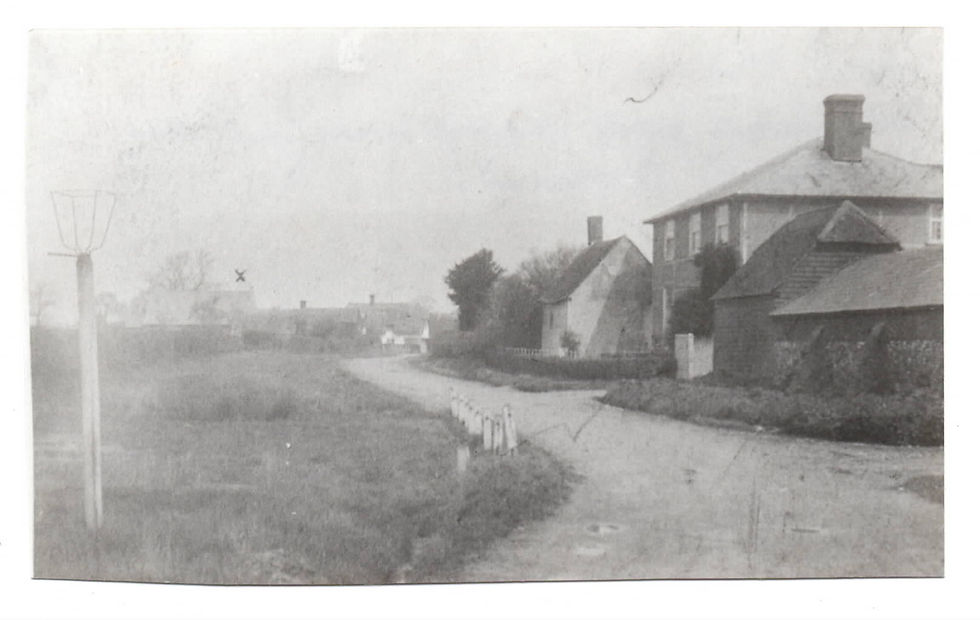
Gilseys
The last name in my examples is Gilseys, or Gilseys and Kings. Still known by this name today, but no-one knew why.
We know where these fields are as they are still used and named as such by the current farmers, and are clearly marked on the enclosure map, so the name certainly goes back to 1808. It didn’t appear in any dictionaries however, and even a search of my trusty church and pre-1661 records didn’t turn up anything this time. It was time to reach out into the wilds of the internet! Or more precisely the storehouse that is Essex Record Office. And true to form, their database came up with an answer.
In June 1638 there was a conveyance from Thomas Gill of Chrishall (Gent.) to a chap called George Bownest of Great Chishill for lands in Chrishall at exactly the spot I was looking for. The boundaries of the land were described in detail including the fact that they bordered land owned by, yes, you’ve guessed, Robert Kynge. This isn’t “Gilseys”, this is “Gill’s”, Thomas Gill’s land next to his neighbour Mr Kynge! And 400 years later his land still carries his name, or at least a form of it.
This is just one tiny item in the huge collection of information we have about Chrishall. Do visit our website or call in and see us when we are open in the summer months. But perhaps also ask around your area for field names and see if they are hiding some lovely history stories in plain sight!
The Chrishall Village Archive celebrates the history of Chrishall, a village steeped in history that stretches back to before the Domesday Book was penned. Their website includes articles and information about the fascinating history of the village and its inhabitants. Their archive is open in the summer months to visit.
You can find out more about Chrishall Village Archive on their website: www.chrishallessex.co.uk
Royston Museum is very grateful to Rosemarie for contributing this guest article to our online exhibitions.